Zero Click SEO: Track AI Mentions That Matter
11/17/2026
When someone searches Google for a product, service, or question, an AI Overview often appears at the top of the results, summarizing the information they need and linking to sources. The searcher reads the answer, gets what they came for, and leaves without visiting a single website.
For businesses, this creates a measurement predicament. Your content might be helping potential customers make informed decisions without generating a single website visit. Meanwhile, competitors offering up similar or even less information may be appearing in AI-generated answers while your brand is simply absent for no definable reason.
Traditional SEO metrics still matter, but website traffic alone just can’t tell you the whole story anymore. Zero click SEO means you are forced to adapt your approach to searches that end without a click to another website, while measuring whether your content is contributing to the outcomes that really matter. That means looking beyond rankings and visits to examine which searches trigger what AI answers, which sources get cited, and how organic performance connects with leads and sales ultimately.
The goal isn't to chase every AI mention or celebrate a score that comes in with no context. It's to understand which searches are landing with your desired audience, what appears when people make those searches, and what the evidence tells you should be doing next.
What Is Zero Click SEO?
Zero click SEO is an approach to search engine optimization that accounts for searches where users find the information they are looking for without clicking through to another website. Rather than measuring success exclusively through organic traffic, it considers how content appears in search results, tracks brand mentions in AI, and looks at whether it contributes to answers in a way that is related to business goals.
This behaviour itself isn't new. Featured snippets, knowledge panels, People Also Ask, and other search features have long since provided answers in other forms directly on the results page. Generative AI simply adds another layer of consideration, with AI Overviews summarizing information from multiple sources and offering links for users who want to explore further.
For example, someone researching the meaning of an industry term might enter a question into Google, read the definition in an AI Overview, and move on without feeling the need to open any of the cited pages. A website may have contributed useful information to that answer, but a conventional analytics report won't do the work to record a visit from that person.
This is where SEO and whatever you want to call generative engine optimization (GEO), answer engine optimization (AEO), or AI search optimization (AIO) find their point of intersection. Traditional SEO remains essential for helping search engines discover, understand, and assess your content the way it has in the past. Optimizing for AI-driven results adds another level of consideration: whether your content is included or cited when an AI-generated answer appears.
When considering just how to optimize your sites for AI Overview inclusion, check out our AI Overview Optimization Guide. You will see that established SEO practices continue to apply to AI search experiences. The challenge becomes measuring these additional outcomes without losing sight of the fundamentals.

How Does Zero Click Search Impact SEO?
Zero-click searches can reduce the number of website visits generated by a search query, even when a page continues to rank perfectly well organically. When an answer appears directly in the results, users may find less reason to click through.
This creates an important distinction between appearing in those search results and generating business value. A website might be cited in an AI Overview without receiving a single visit, just as a brand might be mentioned in an answer without its website even being cited. A visitor might arrive from a search query but never become a customer. These are separate outcomes, and reporting should treat them that way.
Research from Pew Research Center illustrates the potential impact. In a study of browsing activity from March 2025 involving 900 U.S. adults, users clicked a traditional search result on 8% of visits to Google pages with an AI summary, compared with 15% of visits to pages without one. The study observed a difference in click behaviour; it does not mean every business will experience the same traffic decline. Pew Research Center's study of Google users and AI summaries.
It's also important not to connect every little change in your organic traffic to AI. Search demand, seasonality, ranking fluctuations, changes to the results page, and competitor activity can all affect traffic performance just as it did before. Comparing relevant queries over time helps identify usable patterns, but a correlation alone doesn't establish causation.
For a broader perspective on why traffic and business outcomes don't always move together in an easy path, read our blog on Why We Built PowRank.
The takeaway is straightforward: SEO reporting needs clicks, impressions, rankings, and conversions. But now it can also benefit from tracking what happens in AI-generated results before a user decides whether to click.
How to Track and Report Zero Click SEO
Useful reporting begins by becoming knowledgeable about the searches that matter to your business. Instead of starting with a single AI score, build a repeatable process that connects keyword demand, AI Overview results, organic performance, and business outcomes.
Start With a Useful Keyword Baseline
Create a stable list of keywords that reliably covers your priority products, services, informational questions, and commercial comparisons. Separate branded searches from non-branded searches, and distinguish research-oriented queries from those most likely to signal purchase intent.
Add estimated Google search volume using the Google’s Keyword Planner. Record the market, date, and source of those estimates so you can consistently interpret changes. Search volume will help to establish potential demand behind a keyword, but it isn't a count of conversations taking place in AI tools.
Keep your keyword set and checking schedule consistent between reporting periods. If you add new keywords or change the markets you track, document those changes as well, otherwise, a larger sample or a different mix of searches could appear to be a performance improvement when the measurement itself has changed.
Report the Underlying Numbers
Once you have your baseline, report the AI results alongside conventional SEO and business metrics. Percentages can be useful for comparison, but they should always be accompanied by the counts and sample sizes that back them up.
| What to report | Measurement | Where it comes from |
|---|---|---|
| AI Overview presence | Checks with an AI Overview divided by all completed checks; show counts and percentage | PowRank results and export |
| Your site cited | Checks citing your domain divided by checks with an AI Overview; include the cited URLs | PowRank results and export |
| Organic performance | Clicks, impressions, click-through rate (CTR), and average position for relevant queries and pages | Google Search Console, SERP Tool, Google Analytics |
| Business outcomes | Qualified leads, sales, revenue, and conversion rate from measured visits | Google Analytics and CRM |
For this reporting, a check means one recorded result for a particular query, at a particular time and location. Keep your sample comparable across reporting periods, and make the denominator clear for each percentage. None of these metrics independently establish how many people saw an answer or whether an AI citation caused a sale. Their value comes from considering the evidence together.
How to Track Brand Mentions in AI
To track brand mentions in AI, start with a documented set of relevant queries or prompts. For each check, record the platform, exact wording, date, relevant settings, answer, and source URLs. Repeat these checks consistently over time because AI-generated responses can vary.
Classify each result separately, asking questions like; Was the brand named in the answer? Was it actively recommended? Was the company's own website cited? Or did the answer rely on a third-party page that mentioned the company? Keep in mind that a source link does not necessarily mean the answer names or recommends the brand.
For broader LLM brand monitoring, use a defined prompt set and maintain a separate record of results across each of the engines you test. State which platforms were checked and how many prompts or responses were reviewed. Keep this information separate from the Google AI Overview tracking, because results from different systems represent different samples and cannot automatically be compared as though they are the same thing.
Review the context and accuracy of each mention, too. An inaccurate description, outdated detail, or negative recommendation doesn’t count as an unqualified success simply because the brand appeared.
From this, you can start to define a useful monthly reporting structure that should answer four questions: What changed? Which queries and sources help explain the change? What happened to clicks and leads? And what action should the business take next? Take care when describing these patterns, unless you have direct evidence that one change caused another.
Why PowRank Works So Well for This
As we have established, a useful zero-click SEO workflow starts with relevant keywords and examines what Google displays for searches. This is the foundation for PowRank's approach to tracking Google AI Overviews.
PowRank helps you check whether an AI Overview appeared for a selected keyword, which URLs were cited, and whether your target website was included among the accompanying sources. You can also review first-page organic positions and start to build a list of People Also Ask questions, giving you more context for understanding the search results associated with each keyword. Repeated checks and historical records help you compare findings over time and make calculated changes that could benefit your performance. CSV exports allow you to bring those observations into a wider reporting workflow alongside Google Search Console data and business metrics. You can then assess AI results in the context of organic performance, instead of treating it like an isolated score that is the final answer.
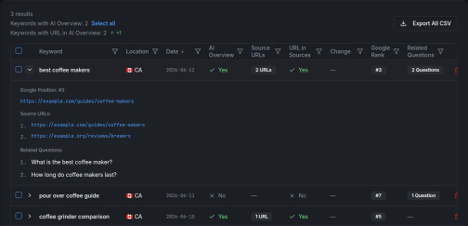
The goal is to move from an observation to an informed and thoughtful next step: identify the searches that matter, see what appears for them, and decide where further SEO work may be worthwhile.
Why I Do Not Think AI Visibility Monitoring Works Well
I have had reservations about AI visibility monitoring because the term ‘visibility’ can make a complicated measurement sound more definitive or reliable than it actually is. A brand might appear in many AI-generated answers, but what does that tell us if we don't know which searches were tested, how relevant they are to potential customers, or how often people actually ask those questions? This makes AI ‘visibility’ monitoring an obtuse and misleading metric.
We cannot have a complete, reliable record of all questions people ask across all AI engines. This makes it difficult to translate a score based on sampled answers into a trustworthy estimate of how many people encountered a brand. The problem isn't that tracking AI responses has no value, it's that the numbers lack context.
For PowRank, we focus on keywords because they give us a defined and measurable starting point. We can use search-volume estimates to understand potential demand and check which searches trigger Google AI Overviews. That doesn't reveal every interaction with AI, but it gives us a specific, repeatable set of results to analyze and base decisions on.
Visible for Which Searches?
Imagine a company appears in an AI response to a prompt that includes its brand name. The result that ensues is different from being recommended in response to an unbranded search such as "best accounting software for small businesses." Both may produce a brand mention, but they answer different business questions and should be treated differently.
The first scenario may help you understand how an AI system describes a company when prompted about it. The second circumstance may offer insight into whether the company appears in a broader category discussion or more generally query. Neither should be interpreted without considering the audience, intent, and business relevance of the query.
A score can also change because the prompt set, weighting, or frequency of checks are also prone to changes. Before interpreting a rise as progress, it is important to check whether the same searches and conditions were used in both reporting periods.
What an LLM Brand Monitoring Score Leaves Out
A percentage of sampled AI answers that mention a brand does not tell us how many real people actually saw those answers, how much real demand the prompts represent, or whether the mentions led to any level of convertible outcome.
A credible report needs to make its methodology clear. It should identify the platforms and prompts tested, the dates and sample size, the answers collected, and the calculation used to produce the score. Without that information, it's difficult to assess what the result actually means.
That doesn't make LLM brand monitoring totally useless, though. Reviewing brand descriptions, competitor recommendations, and recurring cited sources can usefully reveal inaccurate information or opportunities to improve relevant content. The important thing to keep in mind is those findings are evidence for further investigation, not as proof of audience reach.
Search-volume estimates require similar care. Google's Keyword Planner provides historical estimates based on the selected market and period, and its volumes can include close variants that might be useful in the right end goal. But these figures only help to contextualize demand; they are not exact counts of AI searches or impressions.
For that reason, multiplying estimated keyword volume by a citation rate and presenting the result as measured audience reach would be ultimately misleading. The calculation doesn't establish how many people saw the answer. Google Ads keyword metrics.
Ultimately, I want to know which searches we appeared for, why those searches matter, and what changed over time. That's why we start with keywords.
Turn the Report Into an SEO and GEO Action Plan
Reporting is useful when it leads to an informed decision. Once you've identified relevant keywords that trigger AI Overviews, look for opportunities where your website is missing from the cited sources, particularly if you already have a useful page or an established organic ranking for that topic.
Review the sources that appear in the AI Overview and ask yourself; What questions do those pages answer? What supporting evidence do they provide? Is there related information that would help your own page answer the query more completely? Use those observations to improve relevant content with useful evidence and clear explanation, and improve related information to be organized in a way that readers and search systems can understand.
If an AI answer describes your business inaccurately, investigate the source of the information and endeavour to fix it on websites you control. Then document the changes so you can review the results during subsequent checks. Don't assume every change will produce an immediate improvement; use repeated observations over time to assess whether the results have changed.
This is where SEO and GEO start to work together. SEO helps ensure your content is accessible, relevant, and useful to search engines, while GEO focuses on improving the chances that useful content is included or cited in AI-generated answers. Clear explanations, supporting evidence, and well-organized information can benefit both.
Prioritize any further actions based on relevance and potential business value, not simply on how often a keyword triggers an AI Overview. A search important to your business may deserve attention even if it has a modest estimated search volume, while a frequently mentioned topic may have little relevance to your desired customers.
For a practical next step, read our blog on How to Turn AI Overview Data Into an SEO Action Plan.
Measure What Matters Before the Click
Zero click SEO doesn't mean abandoning traditional SEO metrics or, on the flip side, treating every AI mention as a win. It means recognizing that search results can influence decisions before someone even reaches your website, and reporting those outcomes without overestimating what the data can prove.
Start with the keywords that matter most to your business. Check which searches trigger AI Overviews, identify the sources that do appear, and determine whether your site is included. Then compare those findings with organic performance and business results to decide what to improve based on your newfound knowledge!
Start with the keywords that matter to your business. Use PowRank to check which searches trigger AI Overviews, which sources appear, and whether your site is included.
Related posts
GEO vs SEO: Key Differences & GEO Strategy
Learn how GEO and SEO differ, what they have in common, and how to build content for both traditional search results and AI-generated answers.
Read moreHow To Turn AI Overview Data Into SEO Action Plan
How to gather AI Overview from data and turn it in an action plan to generate AI visitors and search visitors.
Read moreAEO (Answer Engine Optimization) Strategy Guide
A practical guide to preparing a AEO (Answer Engine Optimization) strategy.
Read more