AEO (Answer Engine Optimization) Strategy Guide
Tags: aeo, answer-engine-optimization, ai-search, ai-overviews
A practical guide to preparing a AEO (Answer Engine Optimization) strategy.
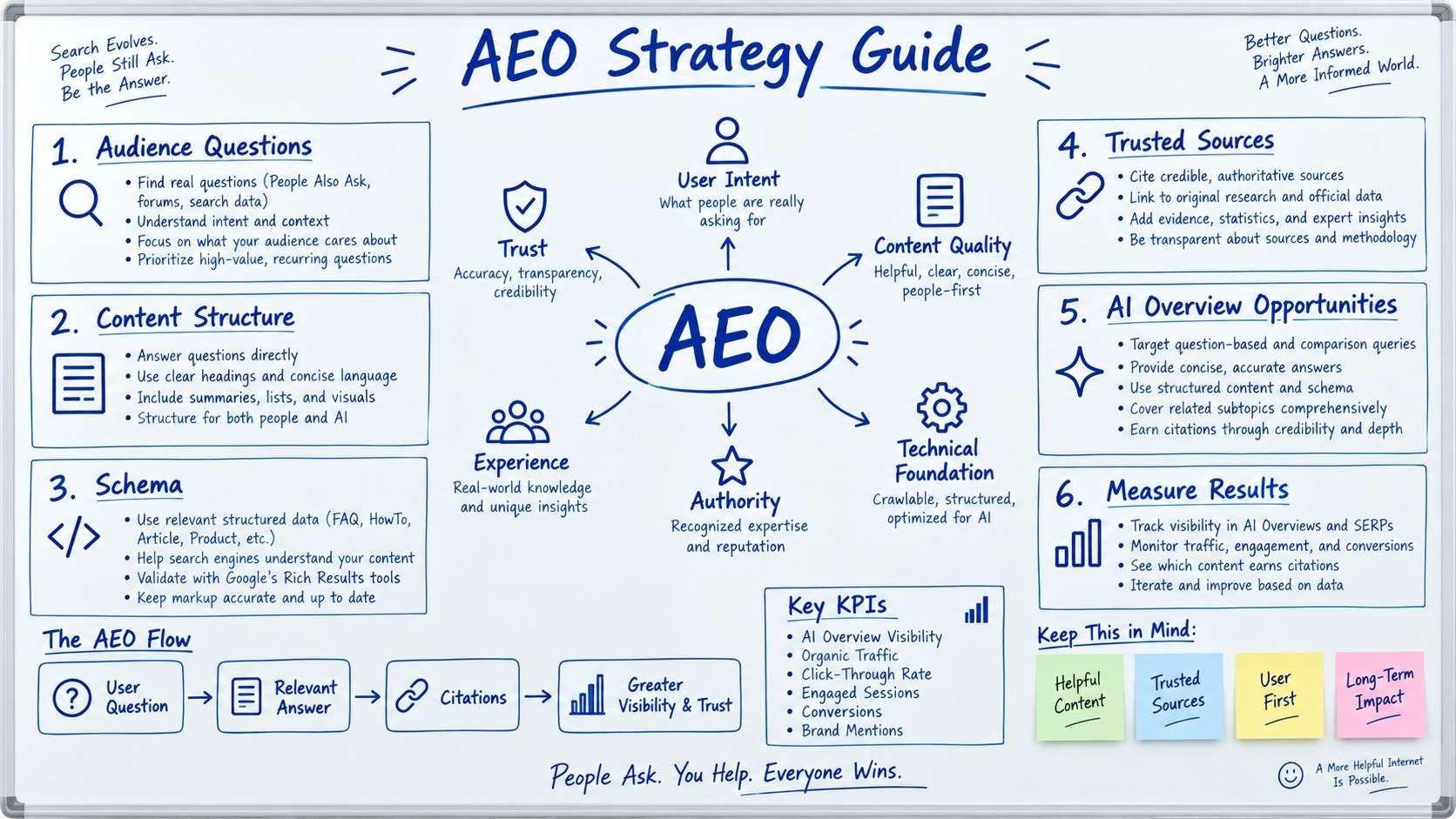
# AEO Strategy: A Practical Guide for Answer Engine Optimization Search is changing. No longer can we target it through a limited list of blue links or strategically placed keywords in natural sounding copy, we have evolved way past that point. While people are still turning to Google to find their information and compare options, they are now being fed direct answers through Google AI Overviews and other handy answer engines such as ChatGPT, Perplexity, Gemini, and Copilot. This changes the landscape of where brands appear and how users discover information. For businesses, this creates a uniquely new optimization problem because gone are the days where pages rank organically or through SEO efforts alone. AI-generated answers appear for the searches that matter to your business, assuming you have the right content on your site and are answering the answers people are truly asking. Hence we have Answer Engine Optimization to help tow the SEO load. Sounds new and scary? Don’t worry, this Answer Engine Optimization guide and AEO best practices is here to help.
This answer engine optimization guide breaks AEO strategy down into a practical, measurable framework that you can actually use. Instead of guessing what might make content more visible in AI-generated answers, we will begin with searches you already care about as a brand and identify where AI answers appear, analyze the sources being cited, and use those findings to guide your content strategy.
Just like any online marketing strategy worth pursuing, a strong AEO strategy starts with measurement. From there, you can identify where your site is already being cited, where competitors are appearing instead, and what content can be improved so that it is easier for answer engines to cite, summarize, and ultimately trust.
## What Does AEO Strategy Mean?
An AEO strategy is a plan for improving how your brand or website can get in on AI-generated answers and summaries. AEO stands for ‘Answer Engine Optimization’, although you may also see terms such as GEO, AIO, or LLM visibility used for similar approaches. Traditional SEO focuses on ranking in search results, but AEO looks more at whether your content is selected, cited, summarized, or referenced in AI-generated answers. Ideally the two work together: strong AEO starts with the SEO foundation you already have, but then is bolstered by data to find where AI searches create new opportunities. Which Answer Engines Should You Target?
You do not need to optimize for every answer engine, you will drive yourself crazy. Instead, begin with the platforms that matter most to how you think your audience searches.
### Google AI Overviews
For SEO, Google AI Overviews deserve priority because they appear directly in Google Search and can sit above traditional organic results; this is prime real estate if you can get in on it. They cite source URLs, creating another way for your content to appear and likely the first place people will go if they want more, and they connect directly to the keyword strategy you already use for SEO rankings.
### ChatGPT ChatGPT matters for brand discovery, education, recommendations, and research-style prompts, so it is important but also limited depending on your needs.
### Perplexity Perplexity is particularly relevant to AEO because it combines the feel of conversational answers with web search and visible source citations.
### Gemini Gemini is important because of its connection to Google's broader ecosystem and henceforth overall visibility. However, Gemini and Google AI Overviews are separate search experiences and should be measured independently.
## What Should Be Included in an AEO Strategy? A practical AEO framework combines the powers of multiple elements, from keyword research, AI Overview tracking and competitive analysis to content improvements and ongoing measurement. A good strategy will reveal where AI-generated answers create opportunities and turn those findings into specific actions.
1. Keyword and Prompt Research AEO starts with the keywords you already use for SEO and expands them into the questions that people are looking to find answers to. Begin with existing SEO keywords, long-tail queries, commercial searches, People Also Ask questions, customer support questions, sales objections, comparisons, and “best,” “how,” “when,” and “which” searches. Traditional keyword tools are still useful here because Google search-volume data is generally more established than prompt-volume data for AI platforms. 2. AI Overview Tracking You need to know how Google AI Overviews appear before you can optimize for them. [PowRank](https://powrank.ai/) tracks which keywords generate AI Overviews, which URLs are being cited, and whether your site is in the mix. Knowing which competitors appear, organic rankings, and People Also Ask sources is also helpful. It turns AEO strategy from a guessing exercise into a quantifiable, keyword-level workflow that you can understand. 3. Organic Ranking Comparison AEO should build on your existing SEO performance rather than replacing it. Compare keywords where you rank and are cited, rank but are not cited, or where competitors are cited instead for important feedback on what needs to change. PowRank also includes first-page organic results to help you identify which existing pages are worth improving first. 4. Source and Competitor Analysis Look at the URLs already being cited for your target searches, especially if they aren’t yours. Analyze those pages to understand what types of content, sources, and information answer engines are selecting for relevant searches, then use those patterns to identify opportunities for content reworking on your own site. 5. Content Gap Analysis Next, identify what your existing site’s content is missing. Depending on the opportunities you have identified from the steps above, that could mean clearer answer blocks, FAQs, comparison content, use-case pages, how-to guides, support content, case studies, or original data where possible. 6. Trust and Entity Signals Answer engines need reliable information about who is providing an answer. Strengthen signals like author information, About and Contact pages, business details, reviews, case studies, third-party mentions, consistent brand profiles, schemas, and reputable citations to add to your own legitimacy. 7. Measurement and Reporting AEO is an ongoing process, so be sure to track changes over time. Check in regularly on AI Overview inclusion, cited URLs, competitor citations, organic rankings, People Also Ask results, completed content updates, and month-over-month changes to understand whether your strategy is actually working. ## AEO Best Practices Good AEO practices make content easier for answer engines and people to understand, cite, and ultimately trust. Keep the fundamentals simple and straightforward: - Answer the main question early. Put a clear, direct answer near the top of each page. - Write concise, quotable paragraphs. Each section should communicate a useful point without fluff or contextually dependent information. - Use relevant FAQs. Address real questions from searchers, customers, and Frequently Asked Questions. - Make headings descriptive. Clearly format H2s and H3s help readers and AI systems understand the page structure. - Support claims with evidence. Use credible sources, examples, data, and original research information whenever possible - Build topic clusters. Create connected content built around important topics and keywords. - Strengthen internal links. Connect informational content with relevant linked pages. - Keep content current. Review and update information often and as your industry changes. - Add trust signals. Include author information, business details, reviews, case studies, and other relevant proof to establish credibility. - Use schema where appropriate. Structured data helps search engines understand your content and entities. - Avoid generic AI content. AI can assist with research and drafting, but thin, repetitive content adds little value and detracts from your goals. ## How to Create an AEO Strategy Here is your practical Answer Engine Optimization strategy broken down into six steps.
**Step 1: Choose Your Priority Keywords**
No need to reinvent the wheel, begin with existing SEO keywords, revenue-driving terms, and informational searches as your foundation.
**Step 2: Track AI Overviews**
Use [PowRank](https://powrank.ai/) to identify which of those priority keywords help to generate Google AI Overviews and which sources are being cited.
**Step 3: Segment the Keywords**
Group your keywords into actionable categories that make sense: already cited, ranking organically but not cited, competitors cited, no AI Overview present, and no organic ranking or citation.
**Step 4: Analyze Cited Sources**
Review the URLs appearing in AI Overviews and look for obvious patterns in content, structure, and information Google is selecting.
**Step 5: Build a Content Action Plan**
Take your findings and turn them into specific actions, you can even use AI to help define these based on your source URL in [PowRank](https://powrank.ai/). Depending on the opportunities you are working with, your work could involve updating an existing page, adding FAQs, creating a blog, developing a comparison page, support article, or case study, or strengthening internal links and other aforementioned trust signals.
**Step 6: Re-Track and Measure**
After making updates, track the exact same keywords again. Monitor your AI Overview inclusion, citations, and organic rankings month over month to see what changes.
## AEO Checklist  ☐ Identify priority SEO keywords
 ☐ Expand research into question-based queries
 ☐ Track keywords generating AI Overviews
 ☐ Record cited source URLs
 ☐ Check whether your site is cited
 ☐ Compare AIO inclusion with organic rankings
 ☐ Review People Also Ask questions
 ☐ Analyze competitor sources
 ☐ Find content gaps
 ☐ Add clear, answer-first sections
 ☐ Add relevant FAQs
 ☐ Strengthen internal links
 ☐ Improve trust signals
 ☐ Add appropriate schema
 ☐ Track results monthly
Follow up your AEO Checklist for strategy with the AEO Audit Checklist, keeping your efforts on track month over month.
## AEO Audit Checklist Use the following checklist to focus help identify where your AEO strategy stands:  ☐ Do your priority keywords generate AI Overviews?
 ☐ Are any of your URLs cited in those AI Overviews?
 ☐ Which competitors appear more often?
 ☐ Do you rank organically but fail to get cited?
 ☐ Do your pages answer the query clearly?
 ☐ Do your FAQs reflect actual search questions?
 ☐ Are your trust signals strong enough?
 ☐ Are third-party sources representing the brand accurately?
 ☐ Do you have content for each stage of your buyer’s journey?
 ☐ Are your seeing and measuring changes over time?
## How to Execute an AEO Strategy AEO execution should be prioritized around the opportunities your data points at, not approached as a random content exercise without information to back it up. 1. Start With Pages That Already Rank These are typically the fastest opportunities because Google already sees the page as relevant. 2. Improve Answer Clarity Add short, direct answer sections near the top of important pages. 3. Add Relevant FAQs Use real questions from Frequently Asked Questions, customer service, sales calls, and keyword research. 4. Build Supporting Content Create guides, comparison pages, glossaries, and other help articles around important topic clusters to improve credibility. 5. Improve Trust Signals Improve your legitimacy by adding proof, examples, reviews, author details, case studies, and third-party validation. 6. Monitor Results Use PowRank to help track whether content changes improve AI Overview visibility, citations, and organic presence over time. ## Common AEO Strategy Mistakes AEO becomes far less effective when it is executed as a separate action from SEO, especially without measuring the starting point first. It is tempting to take short cuts, like creating generic FAQs, ignoring People Also Ask data and organic rankings, tracking unreliable mentions instead of cited URLs, publishing content without legitimizing trust signals, and assuming that only one tool can measure every answer engine perfectly. ## How PowRank Helps With AEO Strategy PowRank helps to make the Google AI Overview side of AEO measurable and therefore actionable. You can track AI Overviews at a keyword level, collect the source URLs being cited, see whether your domain is included when it should be, compare competitor citations, and view first-page organic results alongside AI Overview data. PowRank also collects People Also Ask questions and sources, supports exportable reporting, and lets you monitor changes over time so that you can build out your strategy with confidence. These insights collected month over month can also help you identify which keywords and pages deserve more attention, then measure what happens after you make those changes. What Not to Do When Building an AEO Strategy AEO works best when it is deliberate and measured. Avoid the following traps: - Blindly adding FAQs to every page. Use questions that actually reflect real searches and customer needs. - Chasing every AI platform at once. Start with the answer engines that matter most to your target audience. - Ignoring Google AI Overviews. These overviews connect directly to the Google searches themselves, integrating with the organic rankings you already track. - Relying only on estimated visibility. Track actual AI Overview appearances and cited source URLs wherever possible. - Do not separate AEO from SEO. Your existing rankings, content, and keyword strategy are each valuable starting points for AEO and provide a strong foundation when executed correctly.
## Final Thoughts Although this new way of ranking might seem daunting, AEO strategy should not begin with guesses or generic AI content tactics. It needs to begin with measurement.
A strong AEO framework identifies where AI-generated answers will appear, which sources are cited, where your site is included or missing, and what content needs to improve to get your site featured more. From there, you can make intelligent and targeted changes while measuring results over time.
Want to see which of your keywords generate AI Overviews? [PowRank](https://powrank.ai/) helps you track AI Overview sources, organic rankings, People Also Ask data, and competitor citations so you can build a more measurable AEO strategy that actually works!