How To Turn AI Overview Data Into SEO Action Plan
Tags: ai-overviews, seo
How to gather AI Overview from data and turn it in an action plan to generate AI visitors and search visitors.

# How PowRank Turns AI Overview Data Into an SEO Action Plan
You already know which keywords matter to your business. The service terms, the product searches, the comparison queries, the ones that bring in leads. What you probably do not know is what those keywords are doing inside Google AI Overviews.
That is the gap PowRank was built to close. Instead of guessing, or checking keywords one at a time by hand, you load your list, pick a target country, and see how each one behaves in AI search. Does it trigger an overview? Which sites get cited? Is yours one of them? But the data is not the point. The point is what you do with it.
## What PowRank tracks for each keyword
For every keyword on your list, PowRank answers a few practical questions: - Does this keyword trigger an AI Overview? - If it does, which websites are cited as sources? - Is your target site one of them? - If not, which competitors, publishers, directories, or authority sites are cited instead?
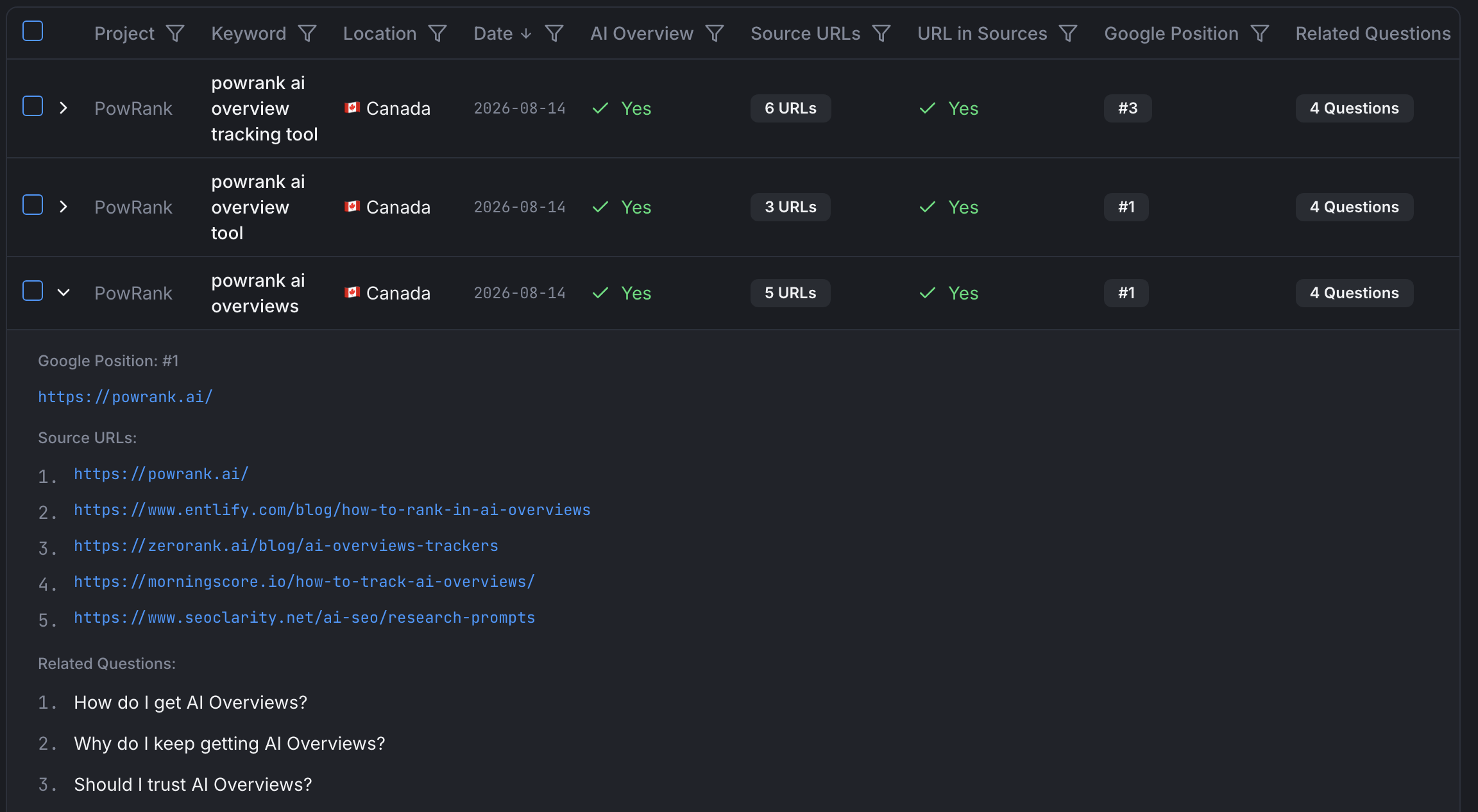
Page-one rankings still matter. AI Overview visibility is a second layer on top of them.
While building the tool, we added two more data points that sharpen the analysis: your first-page organic position, and the People Also Ask questions around each query. Together they answer a bigger question. How does your organic visibility line up with your AI Overview inclusion? The two often diverge. A page can rank well organically and never get cited in the overview. Another can be cited as a source without ranking near the top. Seeing both side by side is where the patterns show up.
## Why the source data is the useful part The single most useful view is which sources Google is citing. If your site is not in the overview, the next question is obvious. Who is? PowRank surfaces the exact pages, competitors, directories, and authority sites being used as sources. That is your starting point. Pull those pages up and look for what they have in common: - Do they answer the query more directly? - Do they have stronger FAQ sections? - Are their definitions, comparisons, and examples clearer? - Are they better matched to the search intent?
This is where tracking stops being a report and starts being useful. The cited sources are Google showing you, query by query, what it treats as a good answer.
## From data to a content plan PowRank gathers the data. The value comes from turning it into a plan. Export your keyword results and the spreadsheet becomes your working document. A lot of teams drop that export into an AI tool and ask it to find the trends across every result at once: - Which topics show up most often among the cited sources? - Which types of pages get cited: guides, product pages, comparisons, directories? - Which keywords already have an AI Overview that does not include your site? - Which of your keywords look most likely to trigger an overview next? - Which updates should you do first?
The goal is not to copy competitors. It is to build a content plan that fits your brand, your users, and your strategy.
Say the analysis shows that cited sources tend to lead with a clear answer, carry strong FAQs, and include comparisons and trust signals. That turns a vague “improve this page” into something specific. Add an answer-first intro. Expand the FAQ. Write the buyer-focused explanation that is missing. Cover the related questions already showing up in the results.
## Run it as an ongoing workflow
AI Overviews do not hold still. Sources shift, competitors come and go, and your own site can start or stop appearing as you change your content. So PowRank is built for repeat checks, not one-time snapshots. Refresh any keyword whenever you want to see what moved, then compare against where you started to see whether your updates actually landed.
A full loop looks like this: 1. Start with your target keyword list. 2. Analyze the keywords in PowRank. 3. Export the results. 4. Identify the patterns and the gaps. 5. Build a prioritized content plan. 6. Make the updates. 7. Refresh the keyword data on your schedule. 8. Compare the new results against your targets.
Exports cover both current data and historical values, so you can track how your visibility changes over time. For a full walkthrough of the platform, see the How to Use PowRank page.
## Measure instead of guess
AI Overview optimization should not run on guesswork. Before you can improve your odds of being cited, you need to know where overviews appear, which sources Google is choosing, and where your site is missing.
PowRank does not replace SEO strategy, content quality, or judgment. It gives you better data to apply them to: which keywords matter, which sources are winning, how your organic visibility compares, and where the real content opportunities are.
AI Overviews are only going to take up more of the results page. The teams that measure this carefully now will be the ones updating the right pages while everyone else is still guessing.
## See what your keywords are doing in AI Overviews
Load your keyword list, pick your market, and see which searches generate AI Overviews, who gets cited, and where your site stands.