GEO vs SEO: Key Differences & GEO Strategy
10/27/2026
GEO vs SEO: Similarities, Differences, and a Practical GEO Guide
Introduction: What Actually Changes With GEO?
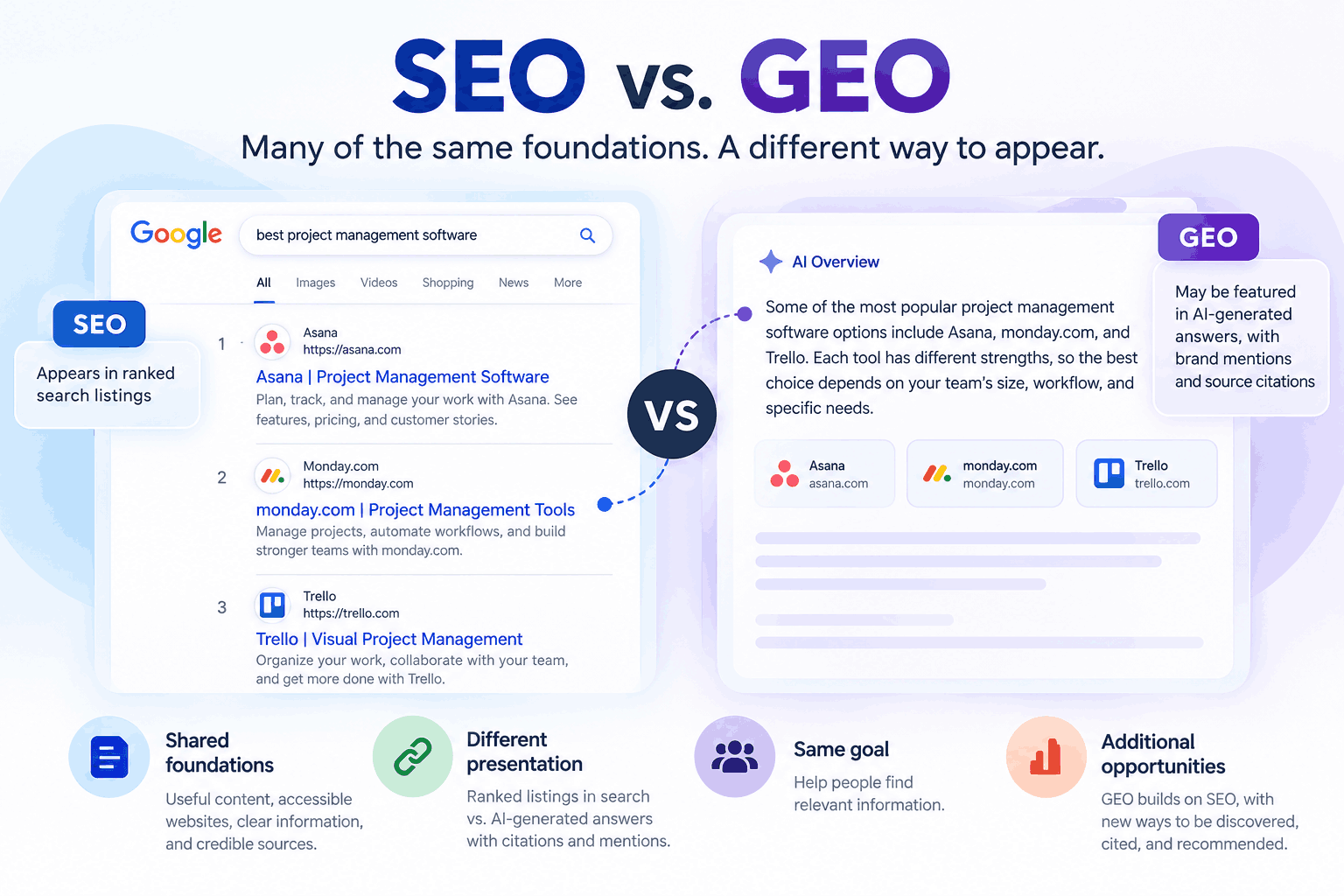
SEO - Search Engine Optimization - helps people find relevant pages to their queries through search engines. Generative engine optimization (GEO), in contrast, focuses on getting the most useful information selected, cited, or accurately represented in AI-generated answers and overviews. The two overlap, but GEO is not a replacement for SEO. It is an additional consideration for businesses that want to understand how their content appears across changing search experiences.
The practical difference is how the end information is presented to the user making the query, which sources are used, and how that performance is measured. Understanding those differences allows businesses to optimize their existing SEO work instead of starting from scratch.
What Is GEO?
Generative Engine Optimization (GEO) is the practice of improving how online content is used or represented in answers generated by AI-powered search engines and assistants. Depending on the platform, user, and question, a business or selection of content might be recommended, mentioned by name, or represented through a citation linking to a specific webpage.
GEO is also known as Answer Engine Optimization (AEO) and AI Search Optimization. These terms are not always used consistently, so their definitions can often vary between practitioners and platforms, which is normal given that this is a fairly new landscape being navigated. The underlying goal is similar: make useful, accurate information that is easier for AI systems to find, understand, and use when responding and presenting information to relevant questions.
One important distinction matters, however, when measuring results: a brand mention is not the same as a website citation. An AI answer might recommend a business without linking directly to its website. It could also cite a particular page without recommending the business directly.
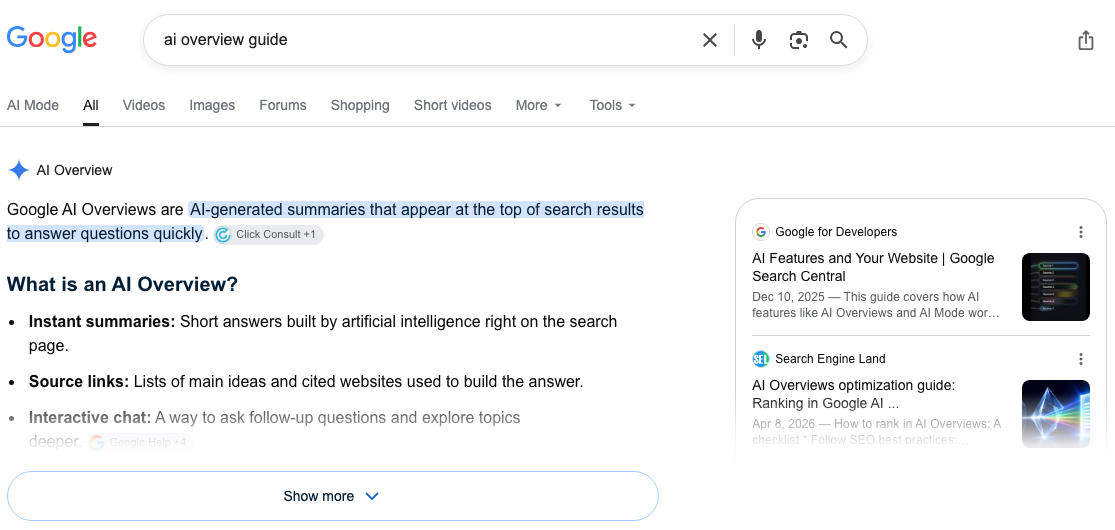
Understanding these differences and nuances is important when assessing how content performs in AI-generated answers. For more background, see our guide to Google AI Overviews.
What Is SEO?
As I am sure you know, search engine optimization is the process of improving a website's ability to be discovered, understood, and ranked in organic search results through a multitude of different tactics. It includes creating helpful content that utilize sought-after keywords, making pages accessible to search engine crawlers, organizing internal links, improving overall user experience while on the site, and building topical relevant authority. SEO also helps search engines understand what a webpage or business offers, which audiences it services, and which pages are most relevant to particular queries. Technical accessibility and clear site structure provide a solid foundation for discovering and interpreting that information when it comes to search rankings.
It is important to remember that these fundamentals still matter when it comes to AI-powered search. Google itself confirms that established SEO best practices remain not just relevant, but also important. SEO has become far more than just taking information from a ‘why us’ approach - it serves to answer informational questions, comparisons, and even helps make buying decisions.
What Do GEO and SEO Have in Common?
Although this GEO guide will introduce new ways to interact with search performance, several established SEO practices remain useful.
Useful, Well-Structured Content
Both disciplines benefit from content that answers real questions accurately and provides enough authority and context for readers to actually understand the subject. Clear headings, descriptive language, relevant examples, and specific details help users navigate a page and help systems easily interpret its purpose so as to serve up its information. Content should clearly explain what a product or service does, who it is for, and any relevant limitations up front. Making important information explicit is generally more useful than relying on vague claims, too much fluff, or promotional language.
Accessible Websites and Good User Experience
Content must be accessible to the systems that are expected to retrieve it. Crawlability, indexability, readable page content, and sensible internal linking each remain pertinent technical considerations. Different AI systems may use different retrieval methods and technical capabilities to gather answers. A page that works well for Google does not automatically work identically for every AI platform, which is important to keep in mind. However, making important information available in readable HTML rather than relying entirely on images or difficult-to-access interactive elements is a practical place to begin.
Structured Data and Consistent Business Information
Structured data can help search engines interpret information about a business, product, service, or webpage, like finding something in an organized filing cabinet versus a messy desk. It should accurately reflect the content users can see on the page. Schema markup is not typically a universal AI optimization shortcut, and adding it does not guarantee a citation or recommendation with AI summaries.
Businesses should keep essential details accurate and consistent across their website and any relevant third-party profiles. For local businesses, that includes elements such as their name, address, phone number, and other information customers need to identify and contact them.
Reviews and Reputation
Reviews, reputable third-party coverage, and consistent descriptions of a business can help people to assess whether a provider or business is credible and suitable. These sources are also fair game when AI systems assemble answers about businesses or products. However, it might be premature to claim that every AI platform weights reviews or brand reputation in the same way. A practical goal is to maintain accurate business information, encourage genuine customer feedback, and correct any misleading third-party descriptions wherever possible.
GEO vs SEO: What Are the Main Differences?
By understanding the differences in light of the similarities, it is possible to build out a strategy that applies to both.
1. Search Listings, Source Citations, and Brand Recommendations
Traditional search results generally present a list of webpages ranked for a query and based on a number of factors. AI-generated answers in contrast may combine information from multiple sources, explain a topic directly, or recommend businesses that appear relevant to the user's needs.
This creates the conditions for several possible outcomes. A company might appear in an AI-generated recommendation, its website might only be cited as a source, or its name could be mentioned with no link at all. These outcomes might be related, but they are not interchangeable.
For example, a business could be named in an answer about service providers without providing a direct website citation. Another business might have a webpage cited to support a factual statement but not be recommended as the best option.
2. Crawler Capabilities and Lightweight Websites
Not every AI system retrieves and processes website content in response to a search in the same way. Google can render JavaScript, but its documentation also explains that JavaScript can introduce additional crawling and rendering considerations when it comes to bots. GEO crawlers are less sophisticated than Google crawlers in this regard. Other systems may have different capabilities or limitations.
This is why making essential content accessible in straightforward HTML is low hanging fruit to prioritize. Important service details, product specifications, and explanations should not exist exclusively in images, scripts, or interactive elements that some systems simply struggle to process.
There is not enough evidence to claim that every GEO crawler prefers lightweight websites or that simpler pages will always perform better, but it is worth considering. The practical recommendation is to make important content accessible, understandable, and technically sound to appease both disciplines.
3. Links, Brand Mentions, and Sentiment
Links remain an established component of SEO. Relevant external links can easily help search engines discover content and provide signals about its context and authority with little effort.
GEO adds another layer of reasoning to examine how a business is described elsewhere. Third-party articles, reviews, directories, and other credible sources may contain information that helps explain a company's products, expertise, or overall reputation. That does not mean brand mentions have been replaced by backlinks, nor that every business needs to pursue a separate campaign to acquire mentions. There is no universal rule that positive sentiment carries the same weight across all AI systems. Instead, a sensible approach is to earn relevant links, maintain accurate third-party information, and look for recurring inaccuracies in how a business or its offerings are described.
4. Answer-Focused Content and Commercial Intent
AI-generated answers often respond directly to questions, so content that explains a subject clearly can be ultimately quite useful when it comes to being cited. This can include (but is certainly not limited to) definitions, how-to instructions, comparisons, buying considerations, and specific reasons a product or service is suitable for a particular customer. However, GEO content should not be limited to informational questions alone, and SEO content should not be limited to just delivering on commercial pages. Both approaches can support the full buyer journey, from early research to evaluating providers and ultimately making a purchase.
The key is to match the content to the user's actual question. A comparison page should explain meaningful differences. A service page should make offerings, applications, processes, and limitations super clear. A technical guide should answer a question clearly, without forcing readers to piece together essential facts from several unrelated pages.
5. Website Visits and Answers Without a Click
An AI-generated answer can satisfy a user's question without prompting a website visit or single click. This can really complicate the relationship between search exposure and website traffic.
Traditional search has also produced zero-click behavior for years, so this is not an entirely new challenge. However, AI summaries essentially change how users interact with the results around them.
A Pew Research Center study published in July 2025 examined US browsing data collected in March 2025. It found that unsurprisingly users were less likely to click a traditional result when a Google AI summary appeared. For marketers, the implication becomes learning to assess more than organic clicks alone. AI Overview presence, cited pages, relevant referral traffic, and business outcomes can easily provide additional context.
6. Conversion Quality and the Buyer Journey
Some marketers observe that visitors arriving from AI tools or searches will appear well informed or further along in their decision making. That is a hypothesis worth testing, but don’t take it as a universal rule.
Conversion rate, total conversions, lead quality, and revenue are drastically different measures. A channel could produce a higher conversion rate with fewer total leads, or generate valuable leads that take a lot longer to convert.
PowRank's guide to AEO return on investment explores how to evaluate the value of these outcomes. The most important principle is to connect AI-related activity to measurable business results when possible, rather than assuming a mention or citation automatically produces some level of commercial value.
7. Keeping Related Information Together
Content is much easier to interpret when related information appears in a logical and connected structure. A page should provide enough context to explain its subject without requiring readers to assemble basic facts from several disconnected locations.
For example, a service page could describe a service, its typical applications, who it suits, and any other important limitations. A separate detailed guide can cover complex technical questions, with internal links that connect the two.
This does not mean repeating every fact across every page. It means making essential information clear where users need it most, keeping descriptions consistent, and organizing supporting content so that the relationship between pages is clear and understandable.
8. llms.txt, brand.txt, and Other AI Files
Files such as llms.txt have been proposed as useful ways to help AI systems navigate or use website content. Some businesses may choose to experiment with these formats, but again, they should not be treated as established requirements for GEO.
Google's guidance on AI features in Search does not require special AI text files for inclusion in those recommendations. There is no universal standard that proves every AI platform uses these files or gives them preferential treatment.
Businesses should instead focus on prioritizing accessible, accurate website content and established technical practices before investing significant effort in optional formats.
9. AI Systems Can Repeat Unsupported Claims
AI-generated answers can sometimes repeat claims found in published material without providing the context required to evaluate them. This creates a practical reason to make important business facts clear and support them with relevant, obvious evidence. For example, if a company claims that its product meets a particular standard, the page should explain the applicable specification and provide supporting documentation where it makes sense. If a service has limitations, those should also be stated rather than left open to vague interpretation.
This is not evidence that AI systems always accept published claims at face value, but it is a good reminder that businesses should make their own information accurate, specific, and well-supported, plus monitor how that information is represented in generated answers.
GEO vs SEO: Similarities and Differences at a Glance
| Area | Key Similarities | Key Differences |
|---|---|---|
| Primary goal | Help people find useful, relevant information. | SEO focuses on organic search rankings; GEO focuses on representation in AI-generated answers. |
| Content | Useful, accurate content that answers user questions. | GEO also considers how clearly information can be selected and incorporated into generated answers. |
| Technical foundations | Accessible content, crawlability, clear site structure, and internal linking. | AI systems will vary in how they retrieve and process content; accessibility does not necessarily guarantee inclusion. |
| Search results | Both help people discover information about businesses, products, and services they are asking about. | SEO produces ranked listings; AI answers may combine sources, cite webpages, or mention brands without providing links. |
| Authority and reputation | Credible information and a trustworthy online presence are important. | Links are an established SEO consideration; how AI platforms use third-party mentions, reviews, and reputation. |
| Content structure | Clear organization and relevant context help people navigate and understand a page. | GEO also considers whether information can be accurately represented within an AI generated answer. |
| User journey | Both support research, comparison, and purchase decisions. | AI answers can satisfy a question without a click, changing how users reach a website. |
| Measurement | Both should be evaluated against meaningful business goals. | SEO tracks rankings, impressions, and clicks; GEO adds measures such as AI answer inclusion, citations, and brand mentions. |
How to Build a GEO Strategy on an SEO Foundation
A practical GEO strategy starts with foundational existing search priorities rather than treating GEO as an entirely separate marketing program from scratch.
1. Choose the platforms and queries that matter. Identify the AI-powered search experiences your audience uses and the questions that are most relevant to your products, services, and purchase decisions. Start with a manageable set of priority queries.
2. Establish a baseline. Record whether AI-generated answers appear for those queries already, and if your business or website is included, which pages are cited, and how your site performs in traditional organic search. Results can vary by platform, query, and market, so keep those overall details consistent.
3. Review the sources and descriptions. Examine which pages and third-party sources actually appear in the answers. Check whether the information is accurate, whether your business is represented appropriately, and which competitors, if any, are being included for specific reasons you can investigate.
4. Improve the most relevant pages. Update existing content that lacks clear explanations, useful details, evidence, or answers to important customer questions. Check technical accessibility, internal links, and the overall accuracy of structured data. Create new content only when there is a genuine gap in information.
5. Repeat the checks and assess outcomes. Revisit the same queries under comparable conditions. Track changes in answer inclusion, cited URLs, organic performance, referral visits, and business outcomes. Use the results to decide which improvements deserve further attention, and prioritize them wisely.
For a more detailed process, check out PowRank's AEO strategy guide.
How to Measure SEO and GEO Together
SEO and GEO should be addressed and assessed together, but their metrics should remain distinct. Organic rankings and clicks describe one part of search performance; AI answer inclusion and citations describe a different one. Neither automatically establishes business impact or assumes inclusion.
| Measurement area | What to track |
|---|---|
| Organic search | Rankings, impressions, clicks, and conversions |
| Google AI Overviews | Queries that trigger an AI Overview, queries that include your site, and cited URLs |
| Other AI platforms | Brand mentions, recommendations, website citations, and factual accuracy |
| Business outcomes | Referral visits, leads, sales, revenue, and conversion rate |
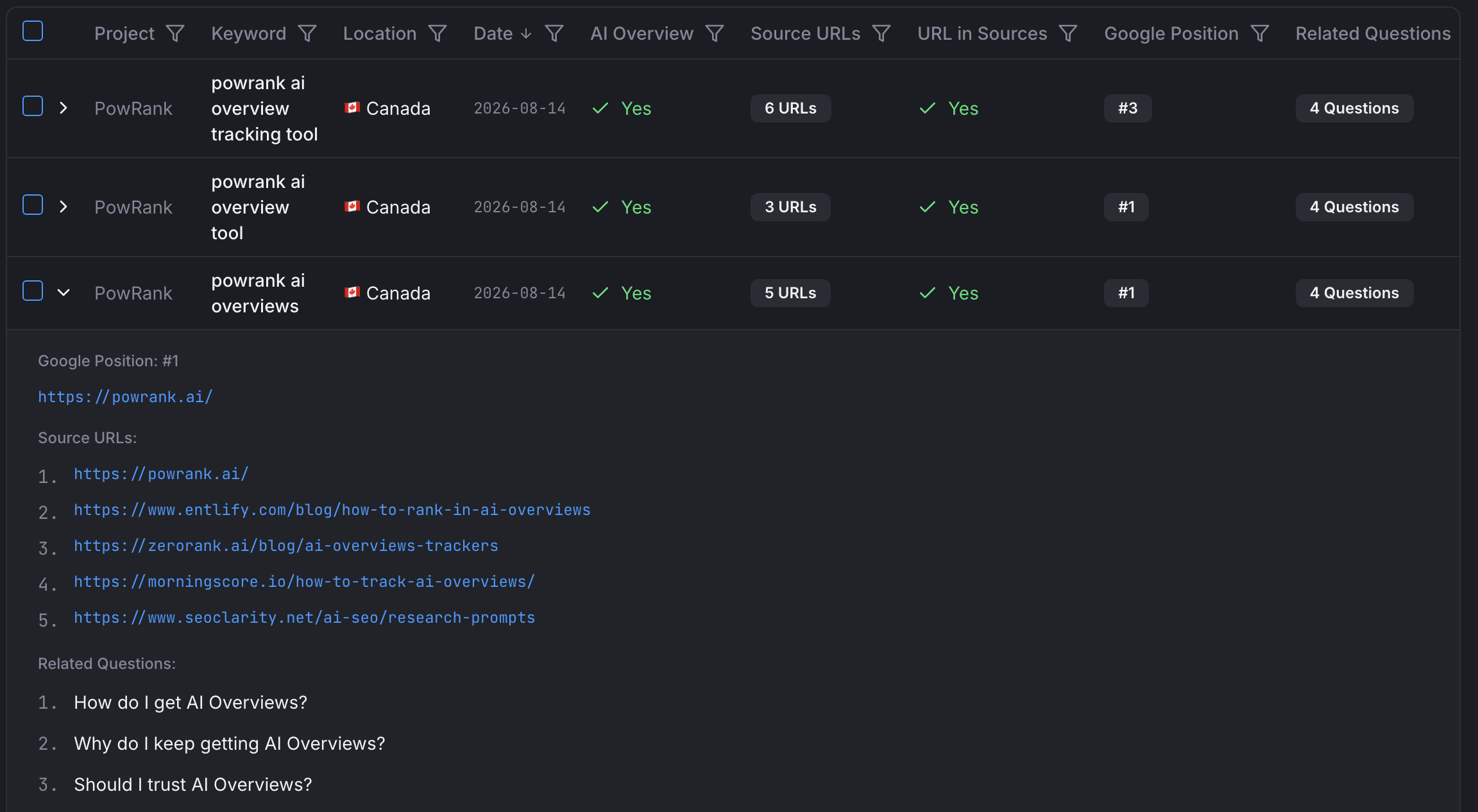
When interpreting AI Overview data, distinguish between two measures:
- AI Overview presence: the proportion of checked queries that return an AI Overview.
- Website inclusion: the proportion of queries with an AI Overview that cite the target website.
Keep in mind that these measures work to answer different questions. AI Overview presence can change even when a site's inclusion rate does not. Report raw counts alongside percentages, and compare the same query set and market across measurement periods whenever possible.
For the next step, connect the search data to actual business results. A citation may indicate that a page is being used as a source, but it does not prove that the citation generated a click, lead, or sale. Referral traffic and conversions can provide useful evidence where attribution is available; other effects could be much harder to measure directly.
See how to turn AI Overview data into SEO actions for further guidance.
GEO Checklist
Use this checklist to review whether your website is prepared for GEO-related testing and improvement: ☐ Identify the AI-powered platforms and priority queries relevant to your audience. ☐ Confirm that important content is accessible as readable HTML. ☐ Provide clear, useful, evidence-based answers to relevant customer questions. ☐ Keep business details, product specifications, and service descriptions accurate. ☐ Ensure structured data matches the information visible on the page. ☐ Use helpful internal links and maintain credible, accurate third-party information. ☐ Track brand mentions separately from website citations. ☐ Establish a baseline and repeat checks using comparable queries and markets.
Conclusion: Build on SEO, Then Measure GEO
GEO changes how businesses need to examine their presence in search experiences, but it definitely does not remove the value of established SEO practices in place. Accessible websites, useful content, accurate information, and credible sources remain a sensible foundation to any smart searchable practice.
Your next step is to identify the queries that matter most to your business, check which ones trigger AI-generated answers, and establish whether your website or brand is already included. From there, you can prioritize content improvements and measure changes alongside traditional organic search performance for the best results. No need to start from scratch, start with the SEO foundation you already have, then use evidence to identify where a GEO strategy can add value.
Related posts
How To Turn AI Overview Data Into SEO Action Plan
How to gather AI Overview from data and turn it in an action plan to generate AI visitors and search visitors.
Read moreAEO (Answer Engine Optimization) Strategy Guide
A practical guide to preparing a AEO (Answer Engine Optimization) strategy.
Read moreAI Overview Optimization: Guide to AI Overviews in Google Search
Learn what Google AI Overviews are, how they work, why they matter for SEO, and how PowRank helps track sources, visibility, and content gaps over time.
Read more