When to Invest in AEO? - PowRank
Tags: aeo, roi, answer-engine-optimization
Is AEO worth investing in now? Find out when AEO makes sense, when to wait, and how to evaluate its ROI alongside your SEO strategy.
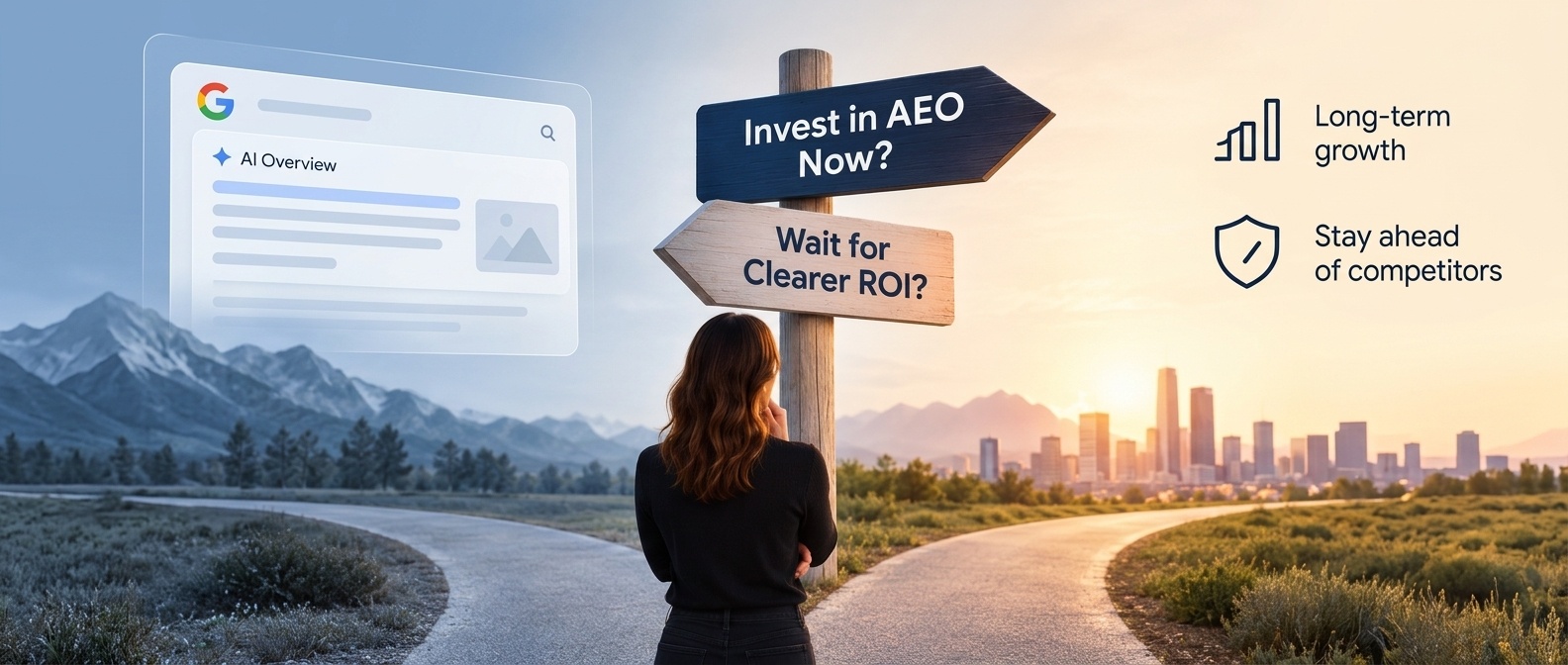
# When Is the Right Time to Invest in AEO? AI Overviews and answer engines are all getting plenty of attention these days, search behavior is changing and so businesses are taking notice.
No one wants to fall behind, but in many cases, the return on an AEO investment is still difficult to prove, and it feels rather obscure. That does not make AEO less important, but it does mean businesses need to be clear about why they are investing and what they can reasonably expect to gain.
AEO can be quite valuable, but it should not always be presented as an immediate traffic or revenue driver.
## Why AEO Is Hard to Justify With Traditional ROI Traditional SEO can often be more directly connected to quantifiable outcomes such as organic rankings, traffic, leads, sales, revenue, conversion rates, and cost per acquisition. All data points that help paint the picture of what your SEO investment is going towards. AEO is harder to measure because the model is still quite new and consistently developing.
AI assistant referral traffic can often seem low, and AI Overview clicks are difficult to isolate. Users can get the information they need without the need to click anything at all. A brand may also be cited or mentioned in an AI-generated answer and influence a decision without generating an identifiable session.
The problem is not that AEO has no value, because it definitely does. The problem is that much of that value is still difficult to prove in the same way we prove SEO, PPC, or other direct-response campaigns.
## AI Assistant Traffic Is Still Usually Low For most websites, visitors from AI assistants such as ChatGPT, Perplexity, Gemini, Claude, or Copilot are still only a small part of total traffic volume. This makes it difficult to build a full ROI case around revenue or leads generated from AI Assistant visitors.
It is important to keep in mind that low AI referral traffic does not necessarily mean low influence. AI tools can answer questions without sending users to a website, attribution can at times be incomplete, and users may research through AI before converting later through direct, branded, paid, or organic searches.
## Are Visitors Interacting Mostly Above the Fold? As search becomes more answer-focused by nature, the content users see first becomes increasingly important. If visitors arrive after doing more research through an AI query, they might be looking for confirmation, proof, pricing, or a clear next step rather than basic education.
This raises practical questions for businesses: Does the page answer a main question quickly? Is the most important information visible without scrolling? Are AI-referred visitors arriving with more specific intent? If AI-driven visitors are arriving later in the decision process, this first screen of content becomes even more valuable.
## Do AI Assistant Visitors Convert Better? Early signs suggest that visitors arriving from an AI assistant may convert slightly better than regular organic search visitors in some cases, but that does not necessarily make AI traffic inherently better.
One possible explanation is intent. Someone arriving from an AI assistant may already have researched the topic, narrowed their options, and identified the questions they still need answered so are already further down the funnel. They may be looking for pricing, proof, comparisons, or a way to contact a business rather than basic educational information.
The important point to consider is the uniqueness of this situation for each business, it isn’t going to be a universal rule.
## The Real Reason Businesses Are Investing in AEO Now Many businesses are not investing in AEO because the ROI is obvious today, but rather because they believe search behavior is changing and they want to be ready.
They may wish to understand how AI search affects their market, protect existing organic performance, learn before the channel becomes more competitive, or build content that works for both SEO and AI-generated answer systems. They may also want to understand how their brand is represented when customers ask AI systems for information or even recommendations. For many companies, AEO is less like buying leads today and more like preparing for where search is going tomorrow.
## When AEO Makes Sense AEO makes more sense when organic search is already an important channel and customers spend time researching a relevant topic before they buy. It can be particularly beneficial for businesses where complex questions, trust, comparisons, or authority influence the buying decision.
That can include B2B services, SaaS, healthcare-adjacent services, legal and financial services, home services, technical products, industrial and commercial equipment, education, and high-consideration ecommerce transactions. It also makes sense when you start to see your competitors appearing in AI-generated answers, the website already has solid SEO foundations, and the business can invest before every dollar of the return is directly attributable.
## When AEO May Not Be the Right Priority Yet AEO should not be used to avoid fixing basic SEO deficiencies, content, tracking, or conversion problems. If a website has major technical SEO issues, weak core service or product pages, little existing organic performance, or poor conversion tracking, those fundamentals really do deserve attention first. A business that needs immediate leads may also get faster returns from paid search or local SEO.
AEO may also be the wrong priority if the budget is limited and cannot support an experimental or longer-term channel, or when AEO alone is expected to produce any sort of short-term ROI.
## AEO Should Build on SEO, Not Replace It Good AEO work often looks and feels like good SEO work. It means answering real customer questions, improving page clarity, creating useful supporting content, building topical authority, strengthening trust signals, using clear headings and internal links, applying relevant schema, and keeping the right content updated. The difference is that AEO puts more emphasis on how content may be summarized, cited, or used when it comes to AI-generated answers.
AEO is not a replacement for SEO, it should instead be considered an extension of SEO for a changing search environment.
## How to Think About AEO ROI While measuring ROI in the context of AEO is a challenge, the ROI question itself should not disappear. It just might require a longer time horizon and a broader measurement model.
Instead of asking only how many leads AEO generated this month, businesses can track AI assistant referral traffic, conversion rates from AI visitors, AI Overview inclusions, citations and brand mentions, organic traffic stability, branded search, assisted conversions, engagement quality, content performance after AEO updates, and any changes in the competitive landscape.
Naturally, not every metric will apply to every business. The goal is to build a measurement model that reflects how the business actually generates revenue with a strong level of consideration in how AI may influence that journey.
## A Practical Decision Framework: Should You Invest in AEO Now? **Invest now if** organic search is already important to your business, your customers commonly research before converting, your industry is likely to be affected by AI-generated answers, and you have a healthy budget to invest in future performance. It also makes sense if you want to monitor how your brand appears in AI search and already has a solid SEO foundation.
**Wait or go slower if** you need immediate lead generation, have major existing SEO or conversion problems, cannot measure basic traffic and conversions, or expect AEO to produce short-term ROI by itself. Fixing core services, products, and landing pages are often a better investment first.
**Start small if** you are interested but cautious. Focus on your highest-value keywords, test with them before committing to a larger program, and update your existing content rather than jumping in immediately to build a large new content operation.
## Final Thoughts: The Right Time Depends on the Business Case AEO is relevant, there is no doubt about that. AI search is growing, and AI Overviews are changing Google results. But not every business should invest in AEO at the same level or for the same reasons, there needs to be thoughtful consideration. For some companies, AEO is a strategic investment in future marketing performance while for others, it may be too early to justify as a major standalone initiative.
The better question is not simply, “Should we do AEO?” It needs to be, “What role should AEO play in our broader search and content strategy right now?”
AEO makes the most sense when it builds on strong SEO fundamentals, supports real customer questions, and is measured with realistic expectations.
Want to understand whether AI search is already affecting your performance? Start by reviewing the keywords that matter most to your business, and then look at whether those keywords generate AI Overviews, whether your site is cited, whether competitors are being used as sources, and whether AI assistant visitors are actually showing up in your analytics.
That data can help you decide whether AEO should be a major focus now, a small test, or a longer-term investment.
If you want a good place to start, read our [AI Overview Guide](/blog/ai-overview-guide).